SubneticFast offline subnet calculator
About
Subnetic is the fast, private subnet calculator for network engineers, admins, and students.
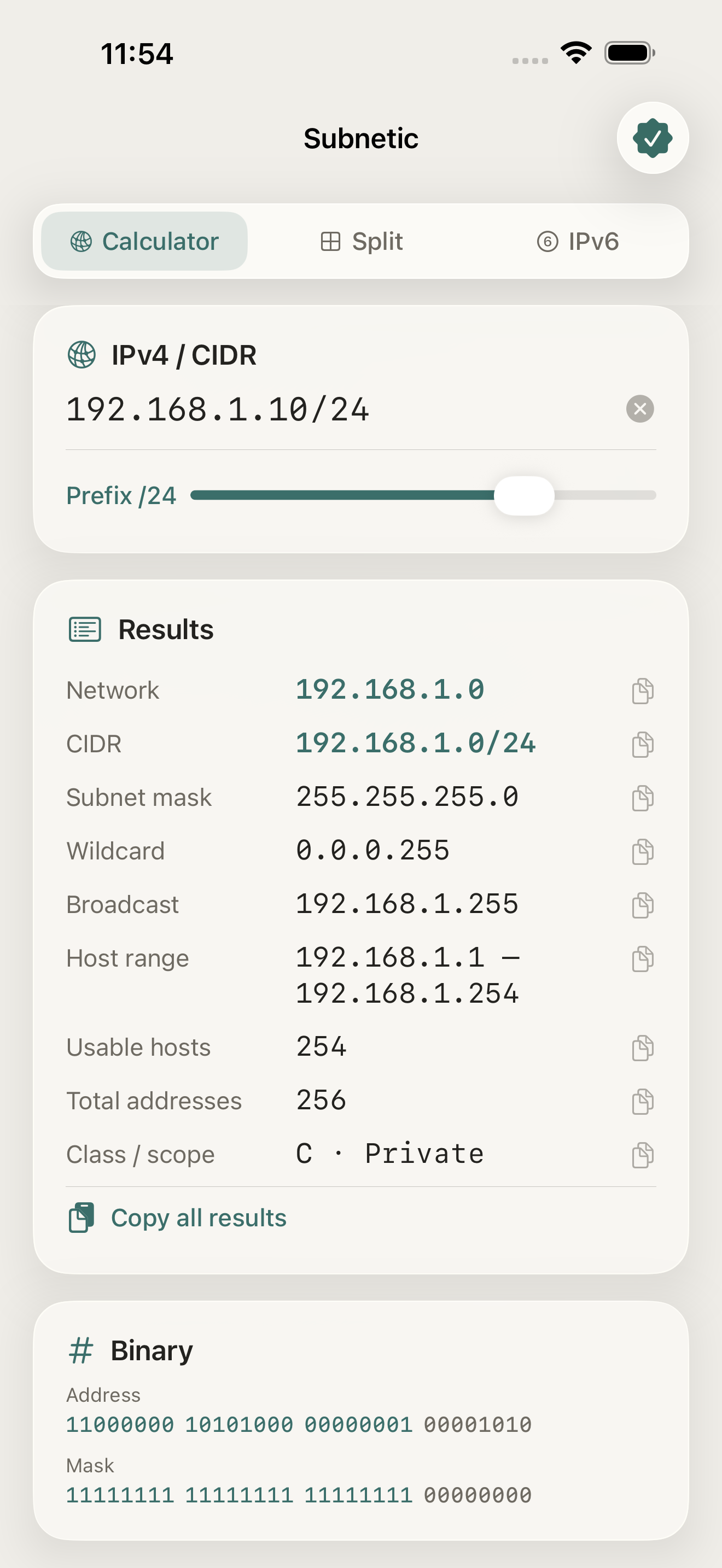
Type any IPv4 address or CIDR and instantly get the network, broadcast, subnet mask, wildcard, usable host range, host counts, address class and scope — plus a live binary breakdown that highlights the network and host bits. It updates as you type, and a prefix slider lets you sweep /0 to /32 in a tap.
WHAT MAKES SUBNETIC DIFFERENT
- Instant IPv4 / CIDR calculation as you type, with a live binary breakdown of network and host bits.
- Dotted-mask and prefix input, aware of RFC 3021 (/31) and /32 — tap any value to copy.
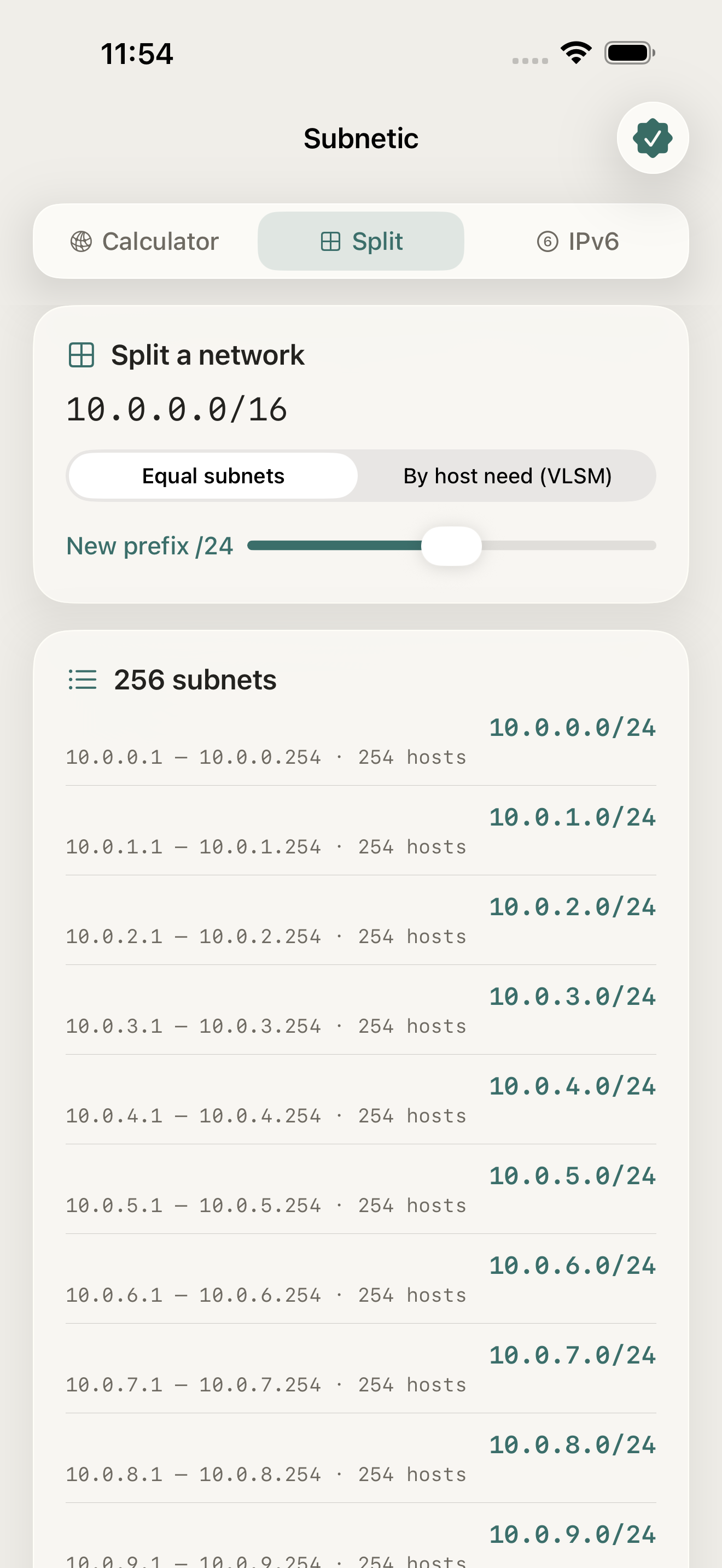
- Subnet Splitter — divide a block into equal subnets, or pack it by host requirement with VLSM (Pro).
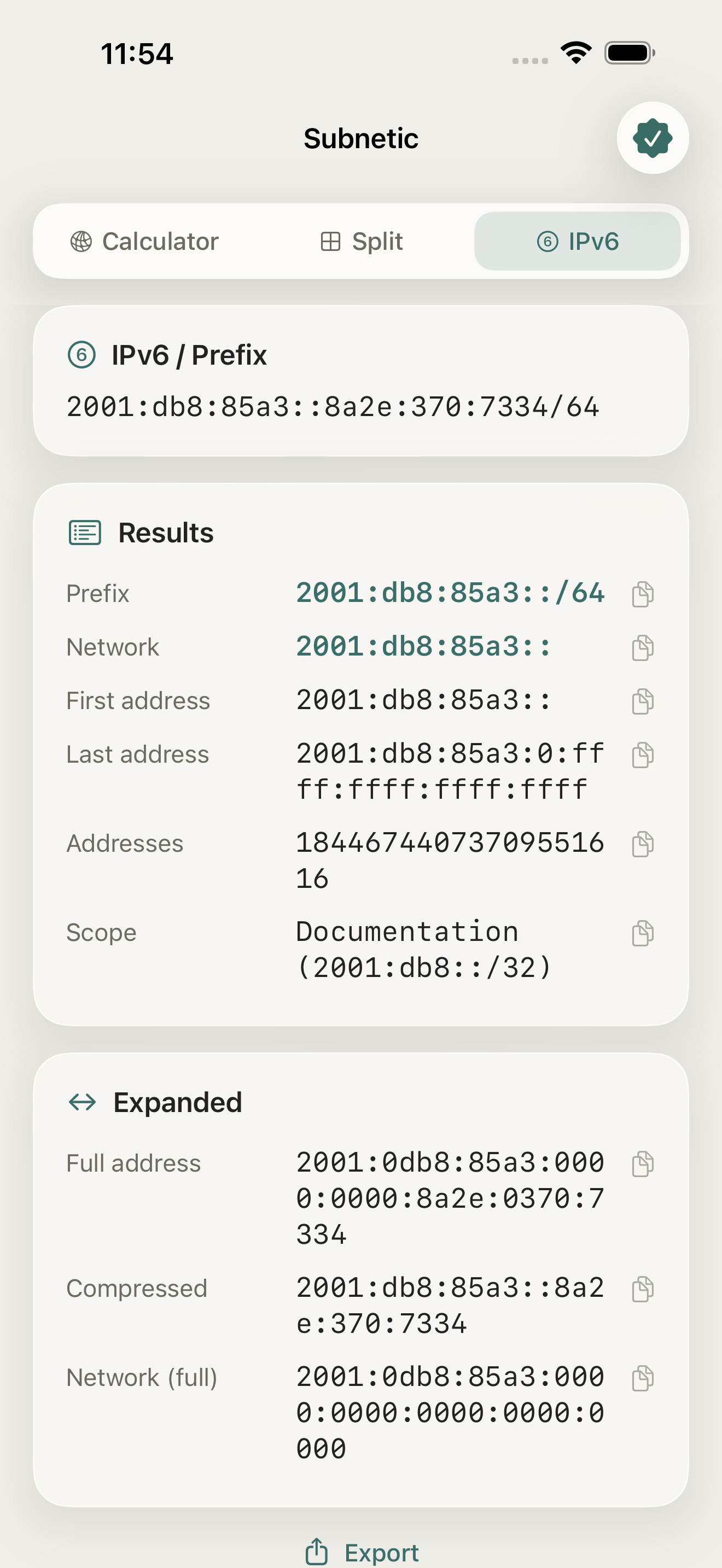
- Full IPv6 calculator — prefix, range, expand/compress, and address counts (Pro).
- Export & Copy All — copy every field at once or share results as text (Pro).
- 100% offline — no accounts, no network calls, no tracking.
PRICING
Subnetic is free, with the full IPv4/CIDR calculator, live binary breakdown, and copy-to-clipboard. Subnetic Pro is a one-time purchase — no subscription — that adds the Subnet Splitter, a full IPv6 calculator, and Export & Copy All.
FEEDBACK
Made by a small indie team. Email obeliskclubclub@gmail.com with feedback, bug reports, or feature requests.
Built with native Apple frameworks and a calm, modern design.
Terms of Use (EULA): https://obelisk.club/subnetcalculator/terms
Core Capabilities
Instant IPv4 / CIDR calculation as you type
Live binary breakdown of network and host bits
Subnet splitter with equal split and VLSM (Pro)
Full IPv6 calculator (Pro)
Export and copy-all (Pro)
100% offline — no accounts, no tracking
Frequently Asked Questions
- How do I calculate a /26 subnet?
- A /26 uses 26 network bits, giving a subnet mask of 255.255.255.192 and 64 addresses per subnet — 62 of them usable for hosts after subtracting the network and broadcast addresses. In Subnetic you can type any address with /26 (or drag the prefix slider to 26) and instantly see the network, broadcast, mask, wildcard, and usable host range, along with a live binary view showing exactly which bits are network and which are host.
- What is CIDR notation and how does it relate to a subnet mask?
- CIDR notation writes an address followed by a slash and the number of network bits, like 192.168.1.0/24 — the /24 is shorthand for the mask 255.255.255.0. It replaced classful addressing so networks can be sized to fit rather than locked to Class A, B, or C boundaries. Subnetic accepts both prefix and dotted-mask input and converts between them as you type.
- Does a subnet calculator need an internet connection?
- No — subnetting is pure arithmetic on the address bits, so there is nothing to look up online. Subnetic runs 100% on-device with no accounts, no network calls, and no tracking, which also means it works in exactly the places network engineers tend to need it: data centers, labs, and sites where the network is down.
- Can Subnetic split a network into smaller subnets with VLSM?
- Yes. The Subnet Splitter in Subnetic Pro can divide a block into equal subnets or pack it by host requirement using VLSM, so each subnet gets just the space it needs. Pro is a one-time purchase, not a subscription, and also adds a full IPv6 calculator and export/copy-all.
- How many usable hosts are in a /31 or /32 network?
- A /32 is a single host address, and a /31 has only two addresses — under classic rules that left zero usable hosts, but RFC 3021 allows both addresses of a /31 to be used on point-to-point links. Subnetic is RFC 3021 and /32 aware, so it reports these edge cases correctly instead of showing a misleading zero.
Interface
High Fidelity UI
High Fidelity UI
High Fidelity UI
More from Obelisk
SnapPro
SnapPro is the professional screenshot and screen recording tool macOS deserves. Pixel-perfect capture, unlimited recording, on-device OCR —…

ViewOne
Your iPhone fired off 50 burst photos at the playground. Now they're sitting on your Mac, and you can't bring yourself to sort through them.…

PhotoBridge
PhotoBridge backs up your iPhone photos directly to storage you own — Synology, QNAP, Nextcloud, AWS S3, MinIO, Aliyun OSS, or an external d…
How Subnetic compares
Honest, dimension-by-dimension comparisons — including where the other tool wins.